
Blog

Scroll through our blogs contributed by various Faithful Organizers.





Downsizing - An Emotional Journey
Blog Post by Yve Irish, Professional Organizer and Owner of Organizing by Yve, Rochester, NY.
Thinking of moving or downsizing? You are not alone!
Forty-two percent of Baby Boomers (born between 1944-1964) will move or downsize in the coming year, according to a recent TD Ameritrade study.
Moving to a smaller home and decluttering a lifetime of belongings is an emotional and overwhelming journey. One of the hardest questions is whether to move at all. However, once the decision has been made to downsize, the emotional decision-making process begins.
Over the years, I've seen many homeowners go through life's transitions and witnessed the emotions this process evokes. Let's look at a few tips on dealing with these tough decisions.
Ask: What should I take? What should I do with the rest?
In order to move to a much smaller home, many people will let go of 30-70 percent of their belongings. This can be a monumental task! Look around your space - what could you let go of?
Certain belongings are easy to donate or discard, such as nicked-up decorations and furniture or old clothing. Personal items holding sentimental value, however, are more difficult to part with. Some things bring back fond memories of family, past relationships, or childhood. Other memories may be painful when remembering family members or friends that have passed on.
As you evaluate each item, ask yourself, "Why am I having such a hard time letting go?"
Are you:
Afraid of giving up objects that belonged to loved ones who are no longer with you?
Feeling guilty about donating gifts that were given by friends or family?
Worried that you may need certain items in the future, especially clothing?
Feeling as if you are giving up on a dream when letting go of unfinished projects, exercise equipment, etc.?
1. Keepsakes- Saying goodbye to grandma's fur coat or china doesn't mean you are throwing away her memory. Not every item represents the person who owned it. Saving a few special items is more than enough to keep the memory alive. Take pictures and create a file or digital album, then pass it on.
2. Gifts- It's okay to let go of gifts given to you. If you don't love it or have use for it, there is no reason to keep the gift. Give it to someone who would love it. Just imagine what your home would look like if you kept every trinket given to you.
3. Clothing- We often hold on to clothing even when we no longer wear them. Some clothes may represent a former time in our lives, such as a career, a different climate or even a different dress size. Keep only what you love and what represents your current lifestyle!
4. Hobbies- People start different hobbies or pastimes over the years. Some stick, some don't. Don't let an unfinished project or unused item create negative feelings. Remember, you are moving on to a new chapter in your life, ready to experience new and exciting things. No reason to let these items hold you back. Just let them go.
If everything is special, then nothing is special.
Keep the best and let go of the rest.
Rather than asking what to let go of, ask yourself, "What should I take with me?"
What items would enrich your life?
What is most precious to you?
Do you love it enough to allot valuable storage space?
Downsizing is never easy, but once you have pared down, you'll experience the freedom of letting stuff go. You're now ready to begin the next chapter of your life, liberated from the responsibilities of maintaining a larger home. Plus, you can rest assured knowing that you've lightened the burden for yourself and your loved ones in the future.
Written by Yve Irish
Owner of Organizing by Yve
585-201-6009
Yve@organizingbyYve.com
Reba Bassett, August Organizer of the Month

Meet Reba Bassett!
Reba Bassett is a professional organizer and the owner of Revelation Organizing, established in 2021. She serves her clients through residential organizing and move management projects with a non-judgmental focus. She lives with her husband and two kids in Austin, TX.
FAITHFUL ORGANIZERS INTERVIEW WITH REBA BASSETT!
Interview hosted by Sangita Evans, Clear and Hear
Check out Reba’s August blog featured on the FO website: “The Only Phrase You Need to Use When Decluttering.”

The Only Phrase You Need to Use When Decluttering
Blog Post by Reba Bassett, Professional Organizer and Owner of Revelation Organizing, Austin,TX.

In the words of a wise woman, "You can't organize clutter." Decluttering is absolutely necessary if you want to be organized. If you find that you can't organize your items, you probably need to get rid of some. No magical organizational tool or container will make your space bigger; you have to do that on your own by getting rid of things. And you can! I promise!
So here you are. You’ve decided to tackle that one space - your guest closet, attic, basement, or box of memorabilia that just needs to be organized. You set aside an hour to fully focus on this task, have your chosen beverage nearby, favorite playlist going, and get to work pulling items out. (First step of organizing a space is to pull everything out, remember?). As you pull items out and sort into what to keep, toss, or donate, you’re left with a group of items that has yet to be decided on. "But HOW do you decide, Reba? It's so hard!" Don't worry, I got you. It's always simpler than you think.
Enter my favorite organizing phrase: Best, Favorite, Necessary. As you go through your items, only keep what is:
The best version of the item. Keep only what's intact, usable, and practical. A mug that's chipped and broken? Toss. Pants that need a new button? Toss. Need to combine items from multiple containers into one? Do it!
Your favorite version of the item. When you look at the pile, does one or two of the similar item stand out to you? Do you have 10 shirts but really only wear 3 because the others have various faults: doesn't fit well, gets wrinkled easy, and on and on? Donate. Now you can look in your closet or on your shelf and only see what makes you happy!
The most necessary item. What is needed and what is extra? Do you have 15 coffee mugs but only use 3 on a regular basis? Keep 6 in case you have company over, and donate the rest. Haven't used your potato masher in years? Donate. The bread maker that you used once but now is taking up way too much space in your cabinet? Donate. This is not minimalism, this is simply living with what you need.
It's amazing how this simple phrase and these three questions can help you focus on what you really need and what you don't. If you ever get stuck or discouraged, just take a look at your donation or toss pile and see all the work you've already done!
"Best, Favorite, Necessary" was coined by one of my favorite small business owners, Emily Ley. She is the founder of Simplified, whose mission is to inspire and empower women with the tools they need to simplify their lives. Their signature product, The Simplified Planner, is my absolute favorite organizational tool - it documents my time and keeps my sanity without any distracting frills a lot of paper planners have. Much of my journey on the road of simplifying my life has come from her company's resources and thoughtful curation of community. Go check them out!
Reba offers organizing services in Austin, TX. She may be contacted at Reba@RevelationOrganizing.com or by calling her at 737-471-5280
Kathleen Murphy, July Organizer of the Month

Meet Kathleen Murphy!
Since 2004, Kathleen has tapped into her organizing strengths to effectively declutter and organize for: downsizing seniors, people who hoard, and folks struggling with chronic disorganization.
In response to the growing needs of clients and their desire to work online, Kathleen earned the designation as a Certified Virtual Organizing Professional (CVOP)™, a Certified Professional Consultant on Aging (CPCA)®, and a Home Staging Expert®.
FAITHFUL ORGANIZERS’ INTERVIEW WITH KATHLEEN MURPHY
Interview hosted by Sangita Evans, Clear and Hear
Check out Kathleen’s July blog feature on the FO website: “Home Staging Decluttering Recommendations”

Home Staging Decluttering Recommendations
Blog post by Kathleen Murphy, Professional Organizer and Founder and Director of Organizing Options®, Montreal, Canada.

Decluttering is essential before your real estate broker considers your home as photo-ready to be listed on the market.
Home stagers can spend over 80% of their time on decluttering a home before the extras are considered, such as freshly cut flowers or a new welcome mat.
Homeowners who’ve lived in their home for 20, 30 or more years probably have a bit of “clutter blindness” on how their home will look to a prospective buyer.
“Clutter blindness” affects people who have lived in a clutter-ish situation for so long that they can’t picture their home looking any other way.
If you've ever been to an IKEA showroom, you may have noticed how spacious the makeshift rooms feel, even when they are rather small. This is due to an absence of clutter and the depersonalization of the showrooms. There are no clutter-obstacles and minimal personal memorabilia displayed in these rooms. This is a guiding principle for a photo and market-ready home.
RECOMMENDATIONS
Remove Personal Items
Family photos: Removing lots of framed family and vacation photos will give potential buyers the chance to imagine their own family photos throughout the house. Yet having just a few can give a feeling of warmth.
Personal care products: Remove shampoo bottles, used bars of soap, and other personal care products from sinks, bath tubs, and shower stalls, and tuck them out of sight. Remove hair brushes, hairdryers, make-up, and medications from countertops – always better not to display your product choices and health ailments.
Pets and related items: Remove all traces of fur, pet toys, dog beds, pet food, and of course your furry friends ahead of a buyer visit. Many people have allergies or are scared of dogs and cats.
Fridge: Clear off the magnets, notes, photos, and drawings. Keep the fridge décor-free for your home visits.
Children’s toys: Contain them in a toy box, a storage box, or on a shelf, not placed on furniture or on the floor.
Minimize the Excess
Do not worry about the empty space in your home; buyers will want to visualize their stuff fitting into the rooms.
From the garage: Having indoor parking is a bonus – declutter the garage. This is the time to declutter everything possible that you no longer want, need, and won’t bring on the upcoming move. Remove garbage, recycling, toxic materials, unused sports gear, broken BBQs, toys, garden supplies, furniture, and old tires.
From the closets: Do not overcrowd the closets. For example: clothes, hall, linen, and kitchen pantry. If every space is packed tightly, it’ll give the impression that there is a lack of space. Best of all, remember to have fun, which is more than possible with proper planning and professional resources.
Contact:
Kathleen offers such services as home staging, move coordination for seniors, and decluttering & organizing consultations to private clients in-person in the area and online.
Kathleen Murphy,
Founder and Director of Organizing Options®, Est. 2004
Downsizing and Move Organizer for Seniors
Montreal: 514-402-0709
Toll Free: 1-800-790-7585
kathleen@organizingoptions.com
Certified Professional Consultant on Aging®
Certified Home Stager, Home Staging Expert®
Certified Virtual Organizing Professional™

Danielle Wurth, Organizer of the Month
Meet Danielle Wurth!
Danielle is a Professional Organizer, Speaker, Founder/CEO of Wurth Organizing, LLC, recovering perfectionist, and soccer mom. Since 2007, she and her team have used her psychology-centered approach to transform over 1,000 family lives. Official Brand Partner with The Container Store in Phoenix and featured in HGTV Magazine and Real Simple Magazine.
FAITHFUL ORGANIZERS’ INTERVIEW WITH DANIELLE WURTH
Interview hosted by Sangita Evans, Clear and Hear
Check out Danielle’s June blog featured on the FO website: "Four Easy Laundry Hacks That Help You Go From Dread To Done."

Four Easy Laundry Hacks That Help You Go From Dread To Done
Blog post by Danielle Wurth, Founder/CEO of Wurth Organizing, LLC, Phoenix, AZ

The endless piles and loads of laundry can be daunting! With a few tips and some favorite laundry room products you can turn laundry time from dread to DONE!
Here are my top four laundry room hacks and solutions that make this daily chore significantly streamlined!
1. Beverage Dispensers for Liquids
Laundry day just got more luxurious… why not? I helped a busy professional client make the everyday laundry grind a bit more inviting! These glass beverage jars from The Container Store did just that. While they no longer sell this version, these glass jars I found on Amazon would work well! Simply pour in your favorite laundry liquids and you are good to go! Nothing feels better than turning the ordinary into extraordinary!

2. Stain Soaking Station
I could not live without a stain-soaking station. Our family invests in nice quality clothes so when a stain occurs everyone in the house knows where to go to prevent it from worsening. Grab your favorite stain remover… ours has always been Dreft Baby Detergent. We rub Dreft liquid directly on the stain with an old toothbrush to remove and release the stain on clothing fibers. Place in the designated soaking system, add another few tablespoons of Dreft to the bowl, fill with water, squeeze and flip the garment a few times. Set to soak thru the day for best results. Wash in regular load or rinse then hang dry. Guarantee stain will be gone!

3. Family Laundry Baskets
Assign and label each family member their own clean clothes laundry basket. Clean clothes and mesh socks and/or sports sacks easily get tossed into their assigned basket. The basket also acts as an efficient delivery system for personal items such as hats or books or bathroom-related products. The Whitmor woven totes have been a hearty favorite in our house due to their soft but hearty woven straps and side handle that makes it easy for little hands to lift. Finish the look with a labeled tag from my custom tag collection.

4. Individual Sport Training Set Sacks
For years I have used a large Whitmor Laundry Mesh Sacks to consolidate, clean, and store EACH soccer uniform set together. Simply adopt this same concept for any sport or activity. Start by placing an ENTIRE practice gear set into a large mesh sack – jersey, shorts, compression, socks. Zip up the sack and identify with a colorful ribbon WHICH child the Sack belongs to. Continue my Sack System concept for the other training and game gear sets. Spend quality time with your kiddo by creating the system together. Decide where dirty zipped Sacks get placed whether be in the everyday hamper or like us prefer the laundry room counter for quicker turnaround. Sack goes into washer, dryer, and then into THEIR labeled clean laundry basket. Total Game Changer like no other!!!!

Hope you enjoyed learning about my favorite laundry room hacks. Please share this blog post to help educate and inspire your loved ones. Is there an area in your laundry room that frustrates you or a daunting chore you dread? Let me know how I can help you become organized and efficient in your daily tasks!
Blog written by Faithful Organizer member, Danielle Wurth. Danielle is a Professional Organizer, Speaker, Founder/CEO of Wurth Organizing, LLC, recovering perfectionist, and soccer mom. Since 2007, she and her team have used her psychology-centered approach to transform over 1,000 family lives. Official Brand Partner with The Container Store in Phoenix and featured in HGTV Magazine and Real Simple Magazine.
blog may contain affiliate links

Parting With Sentimental Items
Blog post by Brenda Tringali, CPO® - Owner, At Your Fingertips Organizing, Myrtle Beach, SC
For many people, it’s difficult to part with items we’ve had for years; if they’re sentimental, it’s even worse. In this blog, I’ll share the impetus to gift a very sentimental item to someone I had never met and never would.
I’ve procrastinated posting this blog for a long time now. The reason? I knew it would bring back a flood of memories… some of which would be sad. I’ve learned that about myself. Because I’m so emotional and sentimental, I tend to gravitate to things (and people) who bring me joy and avoid the rest. But the time has come to share this very personal story with you because it does have a happy ending.
Mom’s Pocketbook:
The day Mom passed, my brother and I gathered up her belongings from her skilled nursing facility. Being the daughter, I automatically assumed responsibility for her pocketbook. I went home and tucked it in a drawer. There it would sit for months because I didn’t have the emotional strength to go through it. I also didn’t have the strength to decide what to do with it. It wasn’t until several months later that I finally had a reason to open that drawer.
At the time, I was living in my hometown in Massachusetts. Unlike Mom, I never had the confidence to run for an officer role in high school. But somehow, just like my Mom, I became very involved in planning almost all of the high school reunions years later for my “sisters” at St. Mary’s High School (SMHS), an all-girls Catholic school.
As we planned our reunion, I learned that one of my favorite nonprofits (Elder Services of the Merrimack Valley), which typically serves clients “of age,” was holding a donation drive called “Project Pocketbook.” They were looking for donations of new or gently used pocketbooks for homeless women. These bags would eventually be filled with the essentials each woman would need when she moved out of the shelter and to a place of her own. The SMHS reunion planning committee loved the idea, so we asked reunion attendees to each bring a pocketbook to the reunion. They were thrilled! And then it clicked for me… Mom’s pocketbook FINALLY had its purpose! So as tough as it was, I finally cleaned out Mom’s bag and polished it up for its future recipient…whom I would never meet.
The High School Reunion/Donation Drive:
The reunion finally came, and my “sisters” and I were all overwhelmed by the mountains of pocketbooks donated that day. But our class even took it one step further. We decided that inside each bag, we would tuck some inspirational words of encouragement. We knew that the day each bag would be opened by its new owner would be an exciting, yet scary day. So we wanted to let them know we were with them in spirit. Each note read:
“If you believe in yourself, anything is possible.”
Miley Cyrus
“The St. Mary’s High School Class recently held its 40th reunion, and this pocketbook was donated by one of the fine graduates of this Catholic, all-girls high school which closed in 1996. It was reopened several years later as Notre Dame Christo Rey High School, and our graduates toured the building so we could take a walk down memory lane and see our new and improved school. We found the beautiful inspirational quote above proudly displayed on one of their walls, and we wanted to share it with you as a reminder to believe in yourself. Please know that We believe in you!!!”
Sending you hugs, love, and hope…
The St. Mary’s High School Class
My Vision of its Future Recipient:
I don’t know who ended up with Mom’s bag, but I do have a visual. In my mind, I see the back of a woman standing in the doorway of the shelter she called home for too long. I see her standing tall, her head held high and her shoulders back as she proudly prepares to take her first step. She has Mom’s black leather pocketbook hung over her right shoulder and she tightly grasps it with her right hand on the strap (as Mom did). She tosses her head to her right to flip her long hair behind her shoulder. And then she takes her first step out of the shelter toward her new beginning. As I picture this, I feel someone grab my hand, and when I look, I’m thrilled to see that it’s Mom. Now in my head, I know that Mom is gone but she’s really always with me, in spirit, and, I do believe in signs. I believe that Mom was looking down… so happy and so proud to see that someone less fortunate was putting her pocketbook to good use. Mom was also thrilled that I had finally parted with it.
How to Handle Your Own Sentimental Items:
Do YOU have sentimental items hidden in a drawer, closet, attic, garage, etc.? Do you think you have too many and want to reevaluate their future? If so, here are some questions to ask yourself about each item. I hope they give you insight into what to do with them.
Can I see/appreciate this item daily or is it hidden in a space where I can’t see/enjoy it?
Does it evoke a good memory or a sad memory?
Am I keeping this out of guilt?
Would my loved one want me to keep this out of guilt?
Would my loved one want me to keep this forever?
If it’s part of a collection (china set, etc.), how much of this collection do I NEED to keep?
What will happen to it once I pass?
Am I burdening my loved ones by leaving this for them to deal with when I pass?
Do I want to be in control of its future while I’m still alive, or do I trust my loved ones to honor my intentions when I pass?
Are there people in need that this could help?
My Answers to these Questions:
As I reviewed these questions, the last one really struck home with me—are there people in need that this could help? Mom was a giver. I know she wouldn’t want me to hang on to her pocketbook. I know that when she no longer wanted or needed it, she would have gifted it to someone less fortunate. Taking the time to ask myself these questions made my decision to gift it to someone in need so much easier .
Summary:
One reason I’m such an effective professional organizer is because I can relate to many of my sentimental clients. Because I’m so nostalgic, I find it difficult to part with certain items… as do they. And because I’m so eco-conscious, my goal is to reduce, recycle, reuse, repurpose, and upcycle as many items as possible to keep them out of the landfill.
When I help clients declutter, many of them are tempted to toss an item vs. donate it. Why? Because they feel it is too old or too worn. But then I remind them that to those less fortunate, it’s the symbol of a new beginning. So please… I know it takes a little extra effort… but please donate your items to those in need. As they say, one woman’s trash is another woman’s treasure.
Not sure where to donate? The top options I always recommend (listed alphabetically) are Goodwill, Habitat for Humanity and Salvation Army. I also love donating to local churches, many of which have parishioners in need or thrift shops.

Should I Be Spring Cleaning?

When visiting my grandmother as a child, I frequently heard stories about how she cleaned her house every spring wearing her “old” high heels. Her home was located in a valley not far from a local steel mill, so this process mostly involved washing black soot from her walls, furniture, fabrics, and floors. Needless to say, I will never achieve such a level of housekeeping perfection, but it has me wondering, “Should I be ‘Spring Cleaning?’” If so, in this day and age, what should that entail?
The truth is, many of us feel a need to refresh as the days lengthen and the air warms. We have a desire to shed the weight of winter, air out, and get things in order. If you are feeling this inclination, take advantage of it by tackling one or all of these projects to “lighten up” this spring.
1. Refresh your wardrobe
Many of us “switch out” our wardrobe when the weather changes. This is the perfect time to take a look at what you own and pass on those items that you no longer need or want. Don’t store items which are ripped, stained, or lack a mate (e.g., an unmatched glove). In addition, if you’ve been moving an item of clothing back and forth for a couple of seasons without wearing it, there is probably a reason. If it doesn’t fit, doesn’t flatter, you don’t love it, or it is out of style, donate it. If you are keeping it for sentimental reasons, move it to a “Memorabilia” box and get it out of your closet.
2. Work the weather-sensitive zones
Locations like garages, attics, sheds, and storage units frequently acquire a build-up of belongings during cold months. Because it is unpleasant to be in these intemperate locations, most of us simply “drop and dump” items inside. Spring provides ideal temperatures for entering these spaces and getting them back in order.
Walk around and return things to their proper locations, such as the correct shelf or the appropriate container. If you can, wipe off surfaces and sweep out these zones.
If you need help lifting, carrying, or reaching items, consider hiring assistance. This might be a college or high school student who can bring items down from a location such as a pull-down attic, or a professional organizer who can help you sort through accumulated belongings in the basement. You may also want to hire a junk hauler to finally cart away that unused treadmill or accumulated construction debris.
Have a look at everything you own. Purge items that are:
· Broken (which you realistically are not going to get fixed)
· Irrelevant to your current needs and lifestyle
· Damaged or decayed so as to no longer be useful
If you are holding onto an item “for the kids,” now is the time to text them some photos and ask them if they actually want it.
Set aside anything that requires specialized disposal, such as old paint, used motor oil, broken electronics, rechargeable batteries, etc. The next step will be to identify ways to dispose of them safely and appropriately. Many towns host a hazardous recycling day in the spring or summer, so find out when the nearest opportunity is and put the date on your calendar. Additionally, many municipalities offer recycling options year-round for specific items, so you may be able to shed them right away. Be aware that disposal of some items often requires a small fee, such as used tires, air conditioners, and old refrigerators.
If your space has never been organized, install some pegboard or other organizing product to keep things in order.
3. Lighten your load
Clear out your purse, backpack, or briefcase. Dump out the contents and shake the bag upside down over a trash can. Toss out any trash. Sort through loose paper and file what you need to keep. Return random items that have landed in your bag to their proper location. Look through your wallet and purge its contents as well.
For more tips on organizing your bag, click here.
4. Improve your view
We are generally better at adding to a bulletin board than we are at clearing it off. The start of a new season is a good time to take everything off and start over.
Get rid of old schedules, reminder notes, and anything out of date. Hang up new schedules, invitations, and reminder cards for spring & summer. If you’ve had the same photo(s) hanging up for a while, consider putting up some new ones. Add a splash of your favorite color, a quote, a comic, or an image of a favorite getaway to inspire you.
A couple of tips for display boards:
· Always keep items within the “border” of the board, not hanging off the edges.
· Use two pins (one in each corner) so that objects hang straight and not at odd angles.
· Avoid overlapping pieces as this will make your board look cluttered and its contents hard to see.
5. Clear out your “scrambled” drawers.
Most people have a drawer or two where items go in but rarely come out. These quickly become jumbled, resulting in frustration it comes time to retrieve needed belongings.
Clearing drawers can be accomplished a little at a time, over the course of the spring season. Drawers make perfect little organizing tasks for rainy days and/or times when you don’t want to get involved in a big project.
Check out this video for how to organize a drawer for step-by-step tips on how to do this.
6. Freshen outdoor spaces
As summer approaches, you may find yourself wanting to spend more time outdoors. If you have outdoor spaces at your home, spring provides the perfect opportunity to get them ready for summer fun.
· Walk around your yard, patio, deck, porch, etc. and do a visual inspection. Note anything that is in need of special attention (e.g., broken, cracked, dirty, etc.) and make necessary repair plans.
· Clean areas that have been unused during winter (e.g., sweep, rake, wash, brush off, etc.)
· Inspect outdoor cooking equipment and refill seasonal supplies (e.g., propane for the grill, wood for the fire pit, etc.)
· Review summer recreational supplies to make sure they are in good shape and ready to use (e.g., swing sets, bicycles, toys, sand boxes, etc.) Discard any supplies that are no longer safe or usable. Donate any pieces that your family has outgrown or that you no longer wish to use.
· If you have a pool, schedule spring maintenance and water delivery.
· When the frost has passed (and maybe after the pollen is finished dropping yellow dust), bring out cushions, pillows, and decorative items.
* * * * *
Spring is the season of new beginnings, the perfect time to start fresh with your space. Do you spring clean?

Make Paperwork an ART
Where in the world is my high school diploma? I know I graduated but I don't think I've seen that piece of paper in the 30 years since. I never thought I'd need it again!!!
This was my panicked thought process two years ago when I needed that diploma—and my college one—to prove that I was eligible to sit for the Certified Professional Organizer exam. A professional organizer who can't find her own vital records—I felt like a fraud!
Thankfully, both diplomas were still in my mother's house right where I stashed them after graduation. Now I have them in my paperwork system and can grab them at a moment's notice. In this blog, I'll help you set up your own simple paperwork system.
ART: My Simple Paperwork System
The biggest hurdle is knowing what to do with all the various papers (both physical and digital) that find their way into our homes. Do I have to do something with this? Do I need to keep this? How long do I have to keep it?
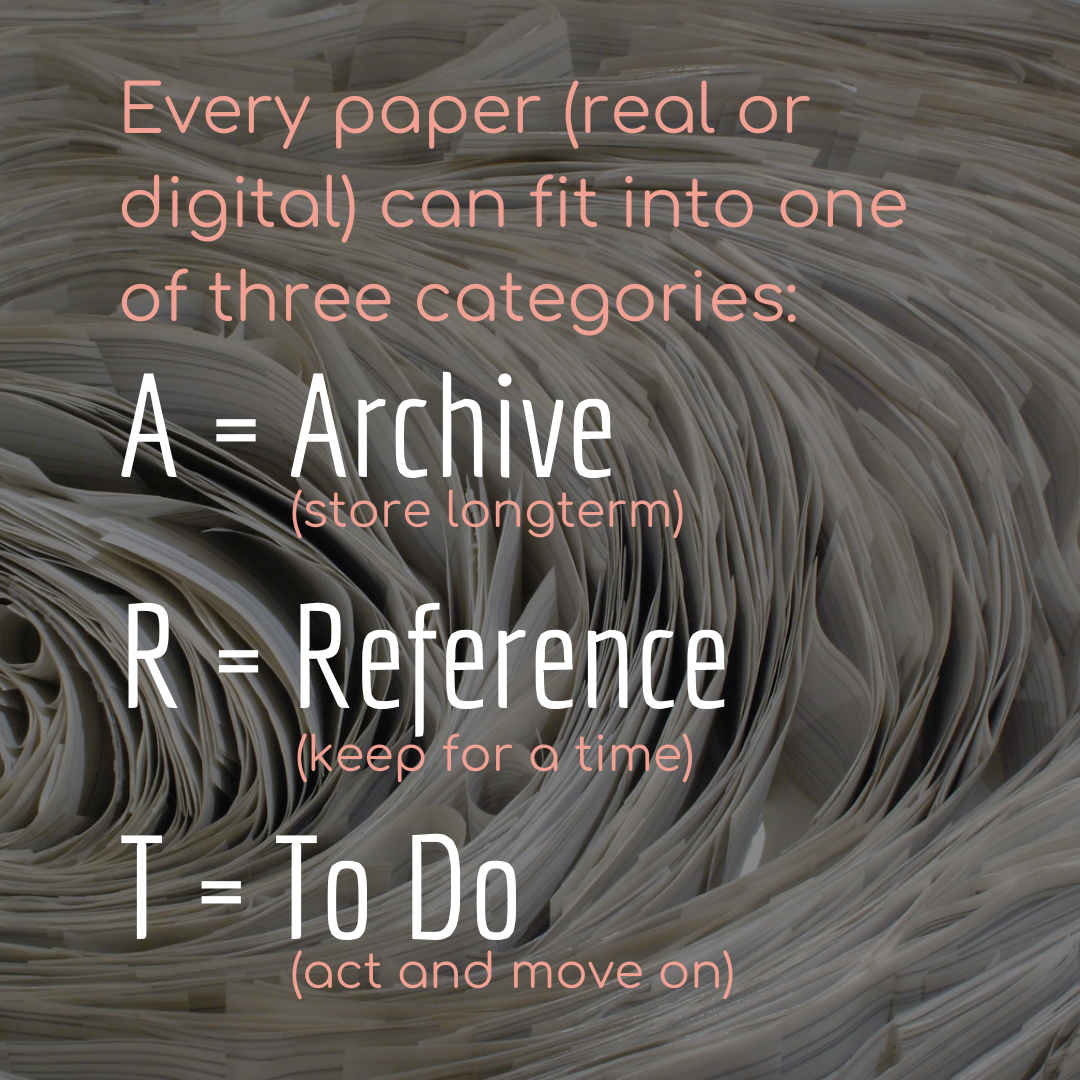
Every paper coming into your home can fit into one of three categories: Archive, Reference, or To Do. ART!
A = Archive
R = Reference
T = To Do
A is for ARCHIVE
Archive is something you have to store long-term or indefinitely.
Examples: Diploma, will, birth certificate, deed, tax records
Goal: Keep Archive documents in a safe place that's accessible when needed but out of the way of everyday life so it doesn't clutter up your space.
Your Archive can be one or a combination of these places: a safe, a fire-resistant document bag, a banker's box in the attic or basement (elevated to avoid water damage), or the bottom (least-accessible) drawer of a file cabinet.
R is for REFERENCE
Reference is something you have to store for a while in case you need the info on it.
Examples: Paid bills, bank statements, pay stubs, insurance policies, medical bills, receipts
Goal: Organize reference information so filing it is quick and retrieval is easy.
Store reference files somewhere convenient so you actually file them, preferably near where mail comes in and near a recycling bin. Reference files can live in the top or middle drawer of a file cabinet, a desktop file box, or even an expanding ("accordion") file case.
Reference files can easily get out of hand, so here are three tips to keep them at bay.
Replacement files: When the new one arrives (e.g. insurance policy), remove and shred the old one.
Go digital! Sign up for e-statements and e-bills. If you still want to save copies, set up a digital file cabinet that mirrors your paper file folders.
Fewer folders = easier to file. Never have a folder that holds just one or two papers. Instead, use broad categories such as Credit Cards, Insurance, and Medical.
T is for TO DO
To Do's are papers that you need to act on.
Examples: Bill to pay, appointment to schedule, form to be signed, email to send, return to process, article to read
Goal: Get these DONE and get on with your life.
Beware the In Tray because that becomes a towering stack of papers! Instead set up an easy-to-see system in a small desktop file box or a cascading wall file with just a few categories (e.g. bills, calls, tasks). Once the To Do's are done, either shred the paper or file it in Reference if necessary.
Are you ready to turn your papers into ART?
Or are you doubtful? Are you looking at a backlog of boxes and file cabinets and stacks? Do you have tons more still coming in? Worrying about the backlog can be paralyzing. Move forward by setting up your ART system to deal with the incoming, then chip away at the backlog bit by bit.
Got 15 minutes? Play some motivating music and grab a stack of papers—just as much as you can hold in one hand. Go through them, getting rid of what you no longer need and putting the rest into your ART system.
Now you're ready to turn your papers into ART!

LOVE has a language of its own!
February: it’s the month of love! Tina Turner recorded a hit song called “What’s love got to do with it?” The chorus says, “What’s love got to do, got to do with it? What’s love but a second-hand emotion…who needs a heart when a heart can be broken?” But, Love’s got everything to do with it! It’s the driving force for everything we do. Love compels us to move forward.
I’m not sure why we only celebrate LOVE in February. I think it’s essential to practice LOVE every day—loving yourself and loving others. Did you know LOVE even has its own Love ”Languages?” Well, we may know them as the “5 Love Languages,” by Gary Chapman. If you are married, you must have dabbled into the topic! Communication seems to be the number one issue in our marriage—because we speak different love languages!
If we were to give people what “they” truly need, not what we think they need, it could mean a world of difference. Whether it’s your spouse, your child, your friends, or your loved ones, getting to know them and asking the right questions could really strengthen that relationship. Love’s got everything to do with it! It never fails.
Well, how can we remember how to love others if we can’t even love ourselves first? What can we do for ourselves that will help us love ourselves and live a more peaceful life? I know that removing the clutter and chaos in our lives leads to a more peaceful and productive day. So, today, let’s focus on remembering the 5 love languages when it comes to loving ourselves!
Words of affirmation
Be kind to yourself. Okay, so you didn’t have a successful year and now you’re afraid to even set new resolutions for this year. Don’t let your past dictate your future! Keep your daily tasks simple. Take one step at a time. Make a list of affirmations for yourself or subscribe to daily affirmations. Keeping a positive attitude and reminding yourself ‘you can do it’ is key to your success. This year you will not let negative thoughts keep you from moving forward!
Quality time
Do you feel you didn’t have enough time to do what you wanted to do? This year, make the time! Put yourself on the calendar and keep that time slot holy! Don’t let anything or anyone interrupt your time. Go get that manicure, massage, or hour of cuddling with a book! You deserve that quality time with yourself. You are worth it!
Physical touch
Okay, stay focused, lol. We’re going to use this reminder to declutter! We will go through our belongings, requiring physical touch, and let go of the things that no longer conjure up good feelings. Do hold onto that fuzzy blanket you love so much! But, let go of items from the past that bring up guilt, sadness, or false expectations. Let them go, and start new. New year, new goals, and new possibilities!
Acts of service
Yes! By letting go, not only are you doing an act of service to yourself, you can donate your belongings to bless others! Schedule a donation pickup every month! When the reminder email comes in that your scheduled donation pick-up is approaching, you will find yourself scrummaging around and looking for items to donate! You will be surprised to find at least a bag of donations ready to leave your space!
Receiving gifts
It’s okay to receive gifts! We love gifts! But, try to remember the “One in, one out” rule. We don’t want to just accumulate. Keep the pipeline open and flowing. Don’t let it get clogged. Keep your blessings coming and freely give them back out!
Try practicing these 5 love languages on yourself. In time, you’ll be a master at identifying the right language of your loved one too. You may have heard this in many weddings, but it is so true:
“Love is patient, love is kind. It does not envy, it does not boast, it is not proud. It does not dishonor others, it is not self-seeking, it is not easily angered, and it keeps no record of wrongs. Love does not delight in evil but rejoices with the truth. It always protects, always trusts, always hopes, and always perseveres. Love never fails.” 1 Corinthians 13:4-8 NIV
So, regardless of what shape your heart is in, if it was broken or hurt, let’s practice some SELF-LOVE! We can’t love others if we can’t love ourselves. How we love ourselves also reflects how we will love others. Sorry, Tina Turner, I have to disagree: love’s got everything to do with it! It’s the very thing that keeps us going. Let’s strengthen it, and have yourself a very Happy Valentine’s Month!

Clouds & Fire: God’s Guidance in the New Year

Photo by Fatih on Unsplash
Whether you set a New Year’s resolution or write down goals for the new year, you need guidance from the One who knows your past, present and future. In the book of Exodus, God gave the people a cloud to guide them by day and a fire by night. We may not have these visible signs to show the way, but we still have clouds and fire.
Clouds: We look to the sky to determine our day. Is it going to be gloomy or bright? Cold or warm? Hebrews 13:8 says Jesus Christ is the same yesterday, today and forever. So, despite what we may think about our day and its continual changes, God never changes. He’s there to guide us in the good and bad. The clouds are our current reminder that He is with us.
Fire: How is your fire today? Are you burning bright for Him or is the flame barely alive? I Thessalonians 5:19 says, “Do not put out the Spirit’s fire.” This passage refers to using your spiritual gifts given by God. Fan this flame and start using the gifts God has given you to serve Him and encourage others.
As professional organizers we often want to plan our days and years with a checklist. This can be helpful, but it often leads to discouragement. Why? Because the list focuses on the physical aspect of life and working through the day in our own strength. God’s plan for your new year is to “seek first the kingdom of God and His righteousness and all these things shall be added unto you,” Matthew 6:33. These things include our physical needs such as clothes, food and drink. Put seeking God first on that checklist!
Seek Him in the new year. Look to the clouds for hope and guidance. Fan the flame through reading the Word, prayer and fellowship. It’s going to be an awesome year!

Simplify the Season & Save Your Sanity
It’s early November, and you know what that means! The aisles of many stores are stocked with ornaments, wrapping paper, and red and green storage bins. . Everybody and their cousin is starting to say things like, “Only ___ more shopping days until Christmas!” Is your stress level already rising just thinking about the buzz of activity around the corner? This blog features suggestions for simplifying your holiday season so you can save your sanity!

Photo by Annie Spratt on Unsplash
Simplify the Season & Save Your Sanity
It’s early November, and you know what that means! The aisles of many stores are stocked with ornaments, wrapping paper, and red and green storage bins. We’re getting messages asking about our preferred dates for a holiday get together. Everybody and their cousin is starting to say things like, “Only ___ more shopping days until Christmas!” And my stress level just went up contemplating the buzz of activity around the corner. How about you?
It’s true—some of your loved ones (or maybe even you, bless your heart) may be gallivanting around like Buddy the Elf, “spreading Christmas cheer by singing loud for all to hear.” But the rest of us are already getting a little anxious just thinking about it. I’m here to help! I’ve gathered some of my best suggestions for simplifying your holiday season so you can save your sanity.
A Simple Schedule
What would you like this holiday season to be like? If you could wave a magic wand and have the next two months go exactly as you wanted, what would that look like? Would your evenings be spent at home, relaxing with some popcorn and hot chocolate, watching holiday movies? Would you drive through neighborhoods admiring the Christmas lights? How about making gingerbread houses with your children or grandchildren? Or maybe you live for those white elephant exchange office parties or rehearsing for the local community theatre production every evening.
While you can’t always arrange your time exactly as you would like, you have more control over your plans than you might realize. If other family members are involved in decisions about your holiday plans, be sure to get their input. Ask them what makes the season special with a prompt like, “It wouldn't really feel like Christmas if I didn’t get to ________.” Have these conversations with loved ones as early as possible, and then adjust your collective calendar to prioritize the events that really matter.
Be sure to leave some “white space,” some unscheduled time where each person can relax in the way they prefer. Some of the most meaningful moments occur during this unplanned free time. Not only that, but the more rested you are, the more you’ll enjoy the planned activities. So save some days just to chill; you’ll absolutely be glad you did!
Standardize or Skip the Gifts
Try giving yourself a break and giving everyone the same thing. I know, it sounds like that should be illegal. I promise there is no gift giving police force out there hunting for those who break the “rules.” It’s 100% okay to give everyone on your list a gift card if that’s what they want. Aren’t we supposed to be giving people something they want anyway? If the gift recipient has an online wishlist, they just made your job much easier!
One year my husband’s extended family decided the adults wouldn’t exchange gifts at all. We opted for a long weekend together in a cabin in the Smoky Mountains eating, playing games, reading, hiking, and shopping. Not everyone participated in every activity, and we didn’t even plan ahead much except for what food to bring. It was pretty wonderful and continues to be one of our favorite holiday memories. Why not consider a group experience like this one, or something else completely different?
In general, I’m a big proponent of giving experiences over things when it comes to gifts because they provide the priceless intangibles of time and memories. There are lots of unique ideas—membership to a zoo, museum, gym, etc.; tickets to a play, movie, or concert are just a few. If you don’t know the person well enough to know an experience they would enjoy, recruit some help from someone who does. Or just ask them! They might even like enjoying an experience together!
Perhaps you’re part of a family or other group that usually exchanges gifts, but you’re all fortunate to already have most everything you need. Your group could decide to take the money (and time) they would normally spend on buying gifts and bless a needy family, a nonprofit or charity whose work the group admires, or some other worthy cause. What a fantastic blessing!
Downsize the Decorations
Depending on the size of your home and the amount of holiday decor you have, decorating for the holidays might take anywhere from an hour to two days. Before our downsize, I devoted a full day to decorating and another full day to taking everything down. I mostly enjoyed it, but an entire day is a lot of time to give up.
Now that we’re in a much smaller space, decorating for the holidays takes much less time, and I love that! I still like making and buying new things, but I don’t want to accumulate too much, so I have a strict one in, one out policy.
My parents decided several years ago to simplify their holiday decorations, and now they mostly just put up one very small Christmas tree. You could do the same and scale down in any way that works for you! You could even hire someone to do your decorating for you.
Speaking of outsourcing, you could also pay someone else to do any of the following: shopping for groceries or gifts, buying a Christmas tree, baking goodies, preparing holiday meals, assembling a gift (get it scheduled early!), wrapping gifts, ordering and addressing Christmas cards, house cleaning, and more. If these ideas sound wonderful but hiring someone to do them isn’t in your budget, how about trading services? There are lots of out-of-the-box ideas to gain back more time.
Get Moving & Get Outside
Don’t give up your fitness routine during the holidays if at all possible. I’m not saying this just because it might prevent weight gain over the holidays (although it could help). Exercise, especially when done outdoors, is both invigorating and wonderful for stress reduction. Just a walk around the block can do wonders to lift your spirits and put things into perspective.
I hope these suggestions are helpful for making this holiday season your best yet!
Angie Hyche, CPO®, is a certified professional organizer and the owner of Shipshape Solutions. Her first book, Unholy Mess: What the Bible Says about Clutter is available on Amazon. She loves to hear from readers! Email her at angie@shipshape.solutions.

Controlling Paper Clutter
Paper is one of the most common areas that I hear from my clients that they would like to conquer. It is a basic problem that everyone struggles with! It seems that everywhere we turn, we are collecting paper – whether it’s junk mail, bills, receipts, paperwork from school, tax documents, to-do lists, post-its, business cards, etc. The piles of paper that accumulate and seem to multiply overnight are a constant source of stress – whether we realize it or not! But the good news is – it is something that we actually have the power to control and do something about!
Here are some suggestions to get AND KEEP your paperwork organized!

“It’s Easier to Keep Up Than to Catch Up”
Paper is one of the most common areas that I hear from my clients that they would like to conquer. It is a basic problem that everyone struggles with! It seems that everywhere we turn, we are collecting paper – whether it’s junk mail, bills, receipts, paperwork from school, tax documents, to-do lists, post-its, business cards, etc. The piles of paper that accumulate and seem to multiply overnight are a constant source of stress – whether we realize it or not! But the good news is – it is something that we actually have the power to control and do something about!
Here are some suggestions to get AND KEEP your paperwork organized!
First of all, Start Now! Start with the paperwork that you receive TODAY, not with what has been accumulating for months (or even years!) We will get back to conquering those old piles. However, first we need to set up routines for today so that those piles don’t get worse. You will be amazed that once you set up a system and it’s running smoothly, most of those piles that you accumulated in the past can either be tossed or shredded. But again – that’s a project for another day. Let’s start fresh TODAY!
Most importantly, remember…
Perfection is not your goal – Improvement is!
Most of our papers come in the form of mail. Here are some tips you can easily put into place to improve your mail clutter.
Think of your incoming mail in 4 categories:
Garbage (or recyle)
Action Papers (i.e. bills)
Reading Materials (i.e. magazines, flyers)
Reference Papers (i.e. insurance documents)
Garbage –

The Critical First Step – Open your mail near your garbage can! Throw away or recycle all of the junk mail and ads immediately!
Action Papers –
Next, open each piece of mail that needs your attention. Toss the outside envelope (and the inside envelope if you pay bills electronically.)
Separate your bills and keep them all in one place. I only use file folders that I can file vertically. I have a file on my desk in a vertical desk top organizer labeled “To Pay”. Filing things horizontally (i.e. piles) leads to stacks of papers that end up growing with extraneous paperwork and things can easily get lost that way.
I also have a vertical file on my desk labeled “Future Action” for items that need my attention that aren’t bills, but are still time sensitive.
Reading Materials –
Place items that you want to read where you will actually read them – perhaps on your coffee table or your nightstand or even your car if you spend time waiting in your car for kids, etc. (but be careful not to start accumulating paperwork in your car!)
Reference Materials –
Next, file any documents that you need to keep for future reference (i.e. statements, insurance documents, etc.). Again, using a vertical filing system. Do this immediately if you can. Yes, it will take you a couple of extra minutes – but that is nothing compared to the time that it will take later to try to find that document if it is not filed in its appropriate spot. Just like all of our other possessions, every piece of paper needs a “home”. This includes our important papers. It’s the only way we will be able to find them when we need them. Another option is to have a vertical file folder on your desk labeled “To File” – but I strongly suggest just taking the extra couple of minutes and file them where they belong immediately rather than having to handle that same piece of paper again later. Plus, if you end up needing that paper before you file it in its “home”, you’ll need to needlessly go through all the papers in that To File folder to find it (a waste of your precious time!)
How to Create a Filing System:
There are many ways to create a filing system. The most important thing is to create something that you will be able to easily maintain. Some people like all of their files in alphabetical order. Others prefer broad categories and then sub files within each category. There is no one “right” way. Do what works for you! The important part is that it needs to make sense to you and you need to use it!
Use a file cabinet or smaller file holder depending on how many files you have.
Common categories if filing alphabetically are:
Insurance (separate folder for each type of insurance – auto, homeowners, life, medical)
Automobile Maintenance
Medical Bills – Current Year
Bank Statements
Credit Card Statements
Home Improvements
Tax Documents – Current Year
Common categories if filing by category are:
Finance (subcategories could be bank statements, credit card statements, etc.)
Medical (subcategories could be insurance, bills, health articles, etc.)
Personal (subcategories could be pets, travel, home improvement, etc.)
User Manuals (include warranties, receipts, etc.)
If you are a visual person, consider buying some colorful files or labels. It may sound silly, but this can help make the filing process more enjoyable and you will be more likely to maintain it.
An electronic filing system is also an option that we will discuss in a future blog post. However, as much as we hear about going paperless in the future, it is unlikely that that will ever likely happen 100%. You will always need a paper filing system at home (or at your office). There is no better time to get that started than Now!
And the most important thing to remember is –
Perfection is NOT your goal – Improvement is!
