
Blog

Scroll through our blogs contributed by various Faithful Organizers.




Fall Home Organization: 10 Areas to Reset Before the Holidays
September is a great time to reset your home.
Summer is ending. School and work routines are back, and the holidays are getting closer. But you still have time before the busiest part of the year begins.
That makes September a good month for fall home organization.
You do not need to clean out your entire house or spend every weekend organizing. Instead, focus on the areas that will make everyday life easier now and help you prepare for the holidays later.
Here are 10 areas worth resetting this September.
1. Reset the Entryway
Your entryway is one of the hardest-working areas in your home.
Shoes, backpacks, purses, keys, mail, jackets, and other things can quickly pile up near the door.
Start by removing anything that does not belong there. Then give the things you use often an easy place to go.
You might need hooks for backpacks, a basket for shoes, or a small place for keys.
Keep it simple.
The goal is to make it easier for your family to get out the door and easier to put things away when you come home.
2. Clear the Kitchen
The holidays usually mean more cooking, baking, and time spent in the kitchen.
September gives you time to make the kitchen work better before all of that begins.
Start with the counters.
Do you have appliances sitting out that you rarely use? Is paperwork taking over part of the counter? Are things being stored in the kitchen simply because they do not have another home?
Clear away what does not belong.
Then look inside one or two problem cabinets or drawers.
Decluttering your home does not have to mean doing everything at once. Fixing one problem area can make a big difference.
3. Clean Out the Pantry
Before holiday food starts coming into your house, find out what you already have.
Check your pantry for:
Expired food
Empty packages
Foods your family no longer eats
Duplicate items
Food that needs to be used soon
Then put similar foods together.
Keep baking supplies with baking supplies, snacks with snacks, and canned goods with canned goods.
You do not need matching containers.
An organized pantry should help you see what you have, find what you need, and know what to buy.
4. Get Paperwork Under Control
Paper can pile up quickly.
Mail, school papers, bills, forms, receipts, and appointment information can end up all over the house.
Create a simple place for papers that need your attention.
You can start with three groups:
To Do: Papers that need action.
To File: Important papers you need to keep.
To Shred: Papers with personal information that you no longer need.
Do not wait until you have hours to work on paperwork. Spend a few minutes on it several times a week.
The goal is to keep paper moving instead of letting it pile up.
5. Make Room in the Closets
September is a natural time to look at clothing.
Summer clothes may be moving out, while jackets, sweaters, and cooler-weather clothes are coming back.
Before putting more into your closets, take something out.
Ask:
Does it fit?
Do I wear it?
Is it in good condition?
Do I still want it?
Donate good clothing you no longer need.
This is also a good time to check coats, shoes, scarves, and other seasonal items before you need them.
6. Prepare Your Guest Spaces
If you expect overnight guests during Thanksgiving, Christmas, or other holiday gatherings, do not wait until the week they arrive to clear the guest room.
Guest rooms often become storage rooms during the year.
Start now.
Remove things that do not belong there and decide where they should go.
Check your sheets, blankets, pillows, towels, and basic guest supplies.
Your guest room does not need to look like a hotel. It simply needs to be clean, comfortable, and ready to use.
Organizing before the holidays gives you time to work without the last-minute pressure.
7. Reset the Children's Routines
By September, you usually have a better idea of what is and is not working with the new school routine.
Pay attention to the problem spots.
Are backpacks always on the floor?
Are school papers covering the kitchen counter?
Does everyone struggle to find shoes in the morning?
Are homework supplies scattered around the house?
Instead of telling everyone to “be more organized,” create a system for the problem.
Give backpacks a home.
Create a place for school papers.
Keep homework supplies together.
Put shoes where your children naturally take them off.
Good systems should make everyday habits easier.
8. Check Your Storage Areas
Garages, attics, closets, and storage rooms can become places where we put things we do not know what to do with.
Before adding holiday decorations, gifts, boxes, and seasonal items, spend some time looking at what is already there.
You do not have to empty the entire garage.
Choose one shelf, one group of boxes, or one small area.
Get rid of trash. Donate things you no longer need. Put similar things together.
A little extra space now can make holiday storage much easier later.
9. Update the Family Calendar
Fall schedules can become very busy.
School activities, sports, church events, work, appointments, family gatherings, and holiday plans can all compete for your time.
Use one main family calendar to keep track of important dates.
Look ahead at the next few months.
Add known events now, including:
School breaks
Appointments
Travel
Family gatherings
Church events
Holiday activities
Work commitments
Knowing what is coming can help you decide what you have time to do—and what you may need to say no to.
10. Take Inventory of Holiday Supplies
Before buying more holiday supplies, check what you already own.
Look at your:
Fall decorations
Thanksgiving items
Christmas decorations
Gift wrap
Gift bags
Ribbon
Holiday dishes
Serving pieces
Storage containers
You may be surprised by what you already have.
Get rid of broken items and things you no longer like or use.
Then keep similar holiday items together and label them clearly.
When it is time to decorate, you will know exactly where everything is.
Why September Is a Good Time to Start
Waiting until November or December to organize can add another job to an already busy season.
September gives you breathing room.
You can work on one area at a time instead of trying to fix the entire house right before guests arrive.
Choose the areas that cause the most stress in your home.
You might spend one Saturday on the pantry and another afternoon on the coat closet.
Small projects count.
The goal of fall home organization is not to make your home look perfect.
The goal is to make your home work better for the season ahead.
When You Need More Than a Weekend Project
Sometimes you know what needs to change, but the project feels too big to tackle alone.
Maybe clutter has been building for years.
Maybe you are overwhelmed by paperwork.
Maybe your garage or storage room has become difficult to use.
Or maybe you have tried organizing before, but the systems never seem to last.
A professional organizer can help you decide where to begin, work through clutter, make decisions, and create systems that fit the way you actually live.
Getting help does not mean someone comes in and makes your home perfect.
It means you have someone beside you who can help turn an overwhelming project into manageable steps.
Get Your Home Ready for the Season Ahead
You still have time before the holiday rush begins.
Pick one area from this list and start there.
One closet.
One pantry.
One pile of papers.
One storage shelf.
You do not have to do everything at once to make your home easier to manage.
And if you are ready for some extra help, you can find a professional organizer who can help you create a plan for your home.
Don't wait until holiday stress arrives. Find a Faithful Organizer near you and create a home that is ready for the season ahead.
Visit FaithfulOrganizers.com to search the Faithful Organizers directory and connect with a Christian professional organizer serving your area.
Recycling: how and where by Beth Ruck of Conquering Clutter
Keeping items out of the landfill that could be recycled is important to the health of the earth.
Many people want to recycle as much as possible but do not know where they can do this.
Here is a list of places I have discovered that take diverse types of items:
Blue Jeans: Blue Jeans Go Green-https://bluejeansgogreen.org/recycle-denim/
Sneakers: GotSneakers? https://gotsneakers.com/
Lowes: https://recycling-revolution.com/lowes-recycle-program.html
Home Depot: https://recycling-revolution.com/home-depot-recycle-program.html
Publix: https://csr.publix.com/recycling-at-publix/
Kroger: https://www.kroger.com/b/terracycle
BestBuy: 0https://www.bestbuy.com/site/services/recycling/pcmcat149900050025.c?id=pcmcat14990005002525
Staples: https://www.staples.com/stores/recycling#rec
Check out through a Google search your county Recycling and Hazardous Waste options.
Check your area for facilities that take scrap metal.
Remember that not all items can be donated or recycled and will end up in the landfill.
We can do our small part to keep what we can out of them
Check out through a Google search your county Recycling and Hazardous Waste options.
Check your area for facilities that take scrap metal.
Remember that after items have been donated or recycled that other items will end up in the landfill. We can do our small part to keep what we can out of them.
Check out through a Google search your county Recycling and Hazardous Waste options.
Check your area for facilities that take scrap metal.
Remember that after items have been donated or recycled that other items will end up in the landfill. We can do our small part to keep what we can out of them.
https://www.conqueringclutter.net/post/recycling-how-and-where
Thanks,
Beth
https://www.conqueringclutter.net
Licensed & Insured
Back-to-School Systems: 10 Organizing Tips for a Smoother School Year
As summer winds down, families begin preparing for a new school year. New schedules, homework, activities, and paperwork can quickly create stress if your home isn't prepared.
The good news is that you don't need a perfectly organized home to have a successful school year. A few simple systems can save time, reduce frustration, and help your family start each day with confidence.
Here are ten practical organizing tips you can implement before the first day of school.
1. Create a Family Command Center
A command center gives everyone one place to find important information.
Include:
Family calendar
School calendar
Weekly meal plan
To-do list
Important phone numbers
Incoming paperwork
Place it in a central location where everyone can easily see it.
2. Designate a Backpack Station
Avoid the daily search for backpacks, shoes, and lunch boxes.
Choose one location near your home's main entrance.
Store:
Backpacks
Lunch boxes
Water bottles
Shoes
Jackets
When everything has a home, mornings become much calmer.
3. Organize School Papers
School papers multiply quickly.
Create three simple folders:
Action Needed
To File
Keepsakes
Review papers each evening so they don't pile up on kitchen counters.
4. Set Up a Homework Space
Children don't need a large office.
A small, organized workspace is enough.
Keep these supplies nearby:
Pencils
Pens
Markers
Paper
Calculator
Chargers
Headphones
Reducing distractions helps improve focus.
5. Plan Simple Meals
Busy evenings often lead to last-minute decisions.
Spend a few minutes each weekend planning:
Breakfasts
School lunches
Dinners
Snacks
Having a plan saves time and reduces stress throughout the week.
6. Create an Evening Routine
Many successful mornings actually begin the night before.
Encourage family members to:
Pack backpacks
Prepare lunches
Lay out clothes
Charge devices
Review tomorrow's schedule
These simple habits can eliminate morning chaos.
7. Declutter Closets
Before purchasing new school clothes, remove items that no longer fit or are no longer worn.
Donate usable clothing and organize what remains by category.
An organized closet makes getting ready much easier.
8. Prepare a Grab-and-Go Station
Keep everyday essentials together.
Include:
Healthy snacks
Reusable water bottles
Keys
Wallets
Sunglasses
Chargers
A grab-and-go station helps busy families stay organized.
9. Review Family Schedules Weekly
Take 15 minutes each Sunday to review the coming week.
Discuss:
School events
Sports
Church activities
Appointments
Work schedules
Planning together helps reduce surprises.
10. Ask for Help When Needed
Sometimes life transitions, busy schedules, or overwhelming clutter make it difficult to get organized alone.
A professional organizer can help you create customized systems that fit your family's needs and are easy to maintain.
Getting organized isn't about perfection—it's about creating a home that supports your daily life.
Final Thoughts
The beginning of a new school year is an opportunity to establish habits that bring greater peace and structure to your home.
Choose one organizing project this week. Small, consistent changes often have the greatest long-term impact.
Find a Faithful Organizer Near You
Need help preparing your home for the school year?
Faithful Organizers connects you with trusted Christian professional organizers who can help you organize your home, simplify your routines, and create practical systems that work.
Visit FaithfulOrganizers.com to find a Faithful Organizer serving your area.
Declutter One Drawer: A Small Step That Can Make a Big Difference
When people think about organizing, they often picture an entire house makeover. That can feel overwhelming, especially if you're short on time or don't know where to begin.
The good news is that getting organized doesn't have to happen all at once. One of the best places to start is with a single drawer.
In just 15 to 30 minutes, you can create a small win that builds momentum for tackling larger organizing projects.
Why Start with One Drawer?
Small projects are easier to complete and less intimidating than organizing an entire room.
Completing one drawer can:
Build confidence
Reduce clutter
Save time when looking for everyday items
Create a sense of accomplishment
Motivate you to organize another space
Remember, progress is more important than perfection.
Step 1: Choose One Drawer
Pick a drawer you use often, such as:
Kitchen utensil drawer
Junk drawer
Bathroom drawer
Nightstand drawer
Office desk drawer
Craft supply drawer
Avoid choosing the most difficult space first. Success builds motivation.
Step 2: Empty Everything
Remove every item from the drawer.
This gives you a chance to:
See everything you own
Wipe out dust and crumbs
Start with a clean space
It's much easier to organize when you're working with an empty drawer.
Step 3: Sort Your Items
As you go through each item, create four simple piles:
Keep – You use it regularly and it belongs in this drawer.
Relocate – It's useful but belongs somewhere else.
Donate – It's in good condition but no longer needed.
Discard – Broken, expired, or unusable items.
Be honest with yourself. If you forgot you owned it, you may not need it.
Step 4: Return Only What Belongs
Before placing items back in the drawer, group similar items together.
For example, in a kitchen drawer you might create sections for:
Cooking utensils
Measuring spoons
Can openers
Kitchen scissors
Drawer organizers or small containers can help keep categories separated, but they're optional. The goal is to create a system that is easy to maintain.
Step 5: Leave a Little Empty Space
Many people feel the need to fill every inch of a drawer. In reality, a little open space makes it easier to find and return items.
An organized drawer should feel functional, not crowded.
Tips for Keeping It Organized
Return items to their designated spot after each use.
Avoid using the drawer as a catch-all for miscellaneous items.
Spend five minutes each month removing anything that doesn't belong.
Don't buy organizers until you've finished decluttering.
Simple habits help your organizing system last.
When One Drawer Leads to More
After you've finished your first drawer, celebrate your progress.
Then choose another small project:
A bathroom cabinet
One pantry shelf
A bedside table
A single closet shelf
Small victories build lasting habits.
When It's Time to Call a Professional Organizer
Sometimes clutter has become too overwhelming to manage alone.
A professional organizer can help if:
You don't know where to begin.
You've started organizing but can't finish.
You're preparing for a move or downsizing.
Paper clutter has become unmanageable.
Life changes have made staying organized difficult.
Professional organizers provide practical systems tailored to your home, lifestyle, and goals.
Final Thoughts
You don't have to organize your entire house today.
Choose one drawer.
Finish one project.
Celebrate one success.
Those small steps can lead to lasting changes that make your home more peaceful, functional, and enjoyable.
Find a Faithful Organizer Near You
Need a little extra help getting started?
Faithful Organizers connects you with trusted Christian professional organizers who can help you declutter, create practical systems, and simplify your home.
Visit FaithfulOrganizers.com to find a Faithful Organizer serving your area.
Mid-Year Home Reset: 10 Simple Organizing Projects You Can Finish This Month
Has clutter slowly crept back into your home since January? You're not alone.
Many people begin the year with ambitious goals for organizing, decluttering, and creating better routines. Then life happens. Work gets busy, schedules fill up, children are home for the summer, and before you know it, countertops are crowded and closets are overflowing again.
The good news is that you don't need a complete home makeover to regain control. A mid-year reset can help you reduce stress, improve efficiency, and create a more peaceful home environment.
Here are 10 simple organizing projects you can finish this month.
1. Why Mid-Year Is the Perfect Time to Reset
January isn't the only time to make improvements.
The middle of the year provides a natural opportunity to evaluate what's working and what's not. Before the busy fall and holiday seasons arrive, take a few moments to simplify your space and routines.
A mid-year reset helps you:
Reduce stress
Save time
Improve productivity
Create more functional spaces
Prepare for upcoming seasonal changes
Small improvements made now can prevent bigger problems later.
2. Declutter One Drawer
When people think about organizing, they often imagine tackling an entire room. Instead, start small.
Choose one drawer:
Kitchen utensil drawer
Junk drawer
Bathroom drawer
Desk drawer
Remove everything, discard trash, relocate misplaced items, and only return what you actually use.
Completing one drawer creates momentum and builds confidence for larger projects.
3. Organize Your Pantry
The pantry is one of the most frequently used areas in the home.
Take 30 to 60 minutes to:
Remove expired food
Group similar items together
Create zones for snacks, baking supplies, canned goods, and breakfast items
Place frequently used items at eye level
A well-organized pantry saves time, reduces food waste, and simplifies meal preparation.
4. Refresh Your Entryway
Your entryway sets the tone for your home.
Create designated spaces for:
Keys
Purses
Backpacks
Shoes
Mail
Consider adding hooks, baskets, or a small bench to keep items contained and accessible.
Even a small entryway can become more functional with simple systems.
5. Simplify Your Closet
Closets often become storage spaces for clothing we no longer wear.
Ask yourself:
Have I worn this in the last year?
Does it fit?
Do I feel good wearing it?
Would I buy it again today?
Donate items that no longer serve you and organize what remains by category.
A simplified closet makes getting dressed easier and reduces decision fatigue.
6. Create a Family Command Center
A family command center helps everyone stay on the same page.
Include:
Family calendar
Important phone numbers
School information
Meal plan
To-do lists
Incoming paperwork
This can be as simple as a wall calendar and a few labeled folders.
The goal is to create one central location for important information.
7. Organize Paperwork
Paper clutter can quickly become overwhelming.
Start with one stack.
Sort papers into categories:
Action Required
File
Shred
Recycle
Create simple filing systems for:
Medical records
Insurance documents
Financial information
Home records
Personal documents
Consistent paper management reduces stress and makes important documents easier to locate when needed.
8. Reset Your Cleaning Supplies
Cleaning becomes easier when supplies are organized and accessible.
Gather all cleaning products in one place and:
Discard empty containers
Check expiration dates
Consolidate duplicates
Create cleaning caddies for frequently used items
Store supplies near the areas where they are most often used whenever possible.
9. Review Your Daily Routines
Organization is about more than containers and labels.
The most organized homes have simple routines.
Review your:
Morning routine
Evening routine
Laundry routine
Meal planning routine
Paper management routine
Ask yourself:
"What is creating the most stress?"
Focus on improving one routine at a time.
Small routine changes often create the greatest long-term results.
10. Know When to Hire a Professional Organizer
Sometimes clutter is not simply a matter of motivation.
You may benefit from professional support if:
You feel overwhelmed and don't know where to start.
Life transitions have created significant changes.
You're downsizing or moving.
Paperwork has become unmanageable.
Physical limitations make organizing difficult.
Previous organizing attempts haven't lasted.
A professional organizer can provide objective guidance, customized systems, accountability, and practical solutions designed for your unique situation.
You don't have to do everything alone.
Final Thoughts
Remember, progress is more important than perfection.
You don't need to organize your entire home this month. Choose one project, complete it, and build momentum from there.
Every small step creates a more functional, peaceful, and manageable home.
Find a Faithful Organizer Near You
Need help getting started?
Faithful Organizers connects you with trusted professional organizers who can help you declutter, organize, downsize, manage paperwork, prepare for a move, and create systems that work for your lifestyle.
Visit FaithfulOrganizers.com to find a Faithful Organizer near you and take the first step toward a more organized home.
The Four Things I Hear Most Before Clients Hire Me — by Liz Fackelman, Davidson Organizing, LLC
Deciding to hire a professional organizer is often harder than the organizing itself.
After more than a decade of helping clients reclaim their homes, I've noticed that nearly everyone shares the same concerns before making that first phone call. If you've been thinking about reaching out but keep hesitating, know that you're in good company.
Here are the four thoughts I hear most often—and what I'd like you to know.
1. "I'm overwhelmed."
I understand completely because I've been there myself.
The more blessings we have in our lives, the more complicated life becomes. As the mother of five adult children, I remember seasons when family schedules, activities, paperwork, laundry, and everyday responsibilities felt impossible to manage. Even today, there are moments when life gets ahead of me.
The secret isn't perfection.
It's taking one small step at a time.
Organize one drawer. Clear one countertop. Celebrate that success, then move to the next small project.
Most importantly, remember that you are not alone.
I also encourage clients to embrace the idea of "good enough."
For me, "good enough" means:
I can find what I need.
My home supports my family's daily life.
I enjoy living there.
I'm comfortable inviting friends over.
My home doesn't look like the pages of a decorating magazine, nor does it need to.
Your definition of "good enough" may be different from mine, and that's perfectly okay. My job is to understand your goals—not impose mine.
Of course, if you're preparing your home to sell, the expectations change. Beautifully organized closets, pantries, and storage areas help buyers imagine themselves living there. (Sadly, they don't magically stay organized after closing!)
2. "I'm embarrassed."
Please don't be.
Disorganization is not a character flaw.
When I walk into a client's home, I don't see failure. I see possibilities.
A sculptor sees a beautiful sculpture hidden inside a block of marble. I see systems waiting to be created, categories waiting to emerge, and spaces that can function beautifully with the right approach.
Organizing is simply how my brain works. It's the gift I have to offer others.
I've also learned something important over the years:
Almost every client apologizes before I even begin.
There is absolutely no need.
I've seen homes in every stage of life—from young families with toys everywhere to seniors downsizing after decades in one home. Every situation is different, and every client deserves compassion and respect.
Your privacy is also extremely important. As a professional organizer, I follow a strict code of ethics that includes complete confidentiality.
If your hesitation comes from the fact that we already know each other, I'm happy to refer you to another trusted professional organizer. My goal is simply to help you get the support you need.
3. "I should be able to do this myself."
Maybe.
Maybe not.
There are many reasons organizing can feel impossible, and very few of them have anything to do with motivation or willpower.
Life circumstances
Sometimes life simply gets in the way.
Perhaps you've welcomed a new baby, experienced a medical issue, lost a loved one, work long hours, or are caring for aging parents. Maybe family members aren't on board with staying organized.
These situations are real, and they deserve grace—not guilt.
Lack of interest
Some people genuinely dislike organizing.
That's okay.
Personally, I feel the same way about auto mechanics. I have no desire to learn how to repair my vehicle. I simply want a reliable car, so I hire someone who enjoys that work.
You don't have to love organizing to appreciate the benefits of an organized home.
I happen to love it.
Let me do what I enjoy so you can spend your time doing what you enjoy.
Chronic disorganization, ADHD, or hoarding
If you've never had an organized home—or if disorganization affects many areas of your life—there may be deeper factors involved.
Professional organizers are trained to adapt organizing systems to the way your brain naturally works.
When appropriate, I may recommend additional specialists who can address emotional or clinical issues that fall outside my expertise.
Some clients prefer that I work independently while they focus elsewhere. Others enjoy working side by side so I can coach them through the process.
Both approaches are perfectly acceptable.
One of the things people often don't realize is that professional organizers aren't there to dictate solutions. We're trained to ask thoughtful questions, listen carefully, and help clients discover systems that fit their own personalities and lifestyles.
Lack of organizing skills
This is actually the easiest challenge to solve.
Organizing is a learned skill.
During our sessions, you'll learn practical techniques, creative storage ideas, and simple systems designed specifically for your home and the way you live.
The goal isn't just to organize your space today—it's to give you tools you can use for years to come.
4. "Hiring help feels like giving up."
I'd like to suggest another way to think about it.
Hiring a professional organizer isn't admitting defeat.
It's choosing to invest in your peace of mind.
We hire accountants for taxes, mechanics for our cars, and landscapers for our yards because they have expertise that saves us time, frustration, and money.
Professional organizing is no different.
Sometimes all it takes is an experienced guide to help you move from feeling stuck to feeling hopeful again.
You Don't Have to Do It Alone
Whether you're overwhelmed, embarrassed, unsure where to begin, or simply tired of living with clutter, remember this:
You don't have to figure it out by yourself.
My goal isn't to create a picture-perfect home.
It's to help you create a home that works for you, supports your life, and brings you peace.
If you're ready to take the first step, I'd be honored to help.
Liz Fackelman
Certified Productive Environment Specialist™
Davidson Organizing, LLC
https://DavidsonOrganizing.com
704-293-9312 - from chaos to order in the home & office

SUMMER READING: KIDS’ BOOKS THAT TEACH THE JOY ORGANIZING by Kate Bosch
June is here, and in Rhode Island, that means beach days, backyard adventures, and—yes—long, lazy afternoons perfect for curling up with a good book. When my daughters were young, I cherished snuggling up with a bedtime story. It was wonderful to rediscover classic childhood books with them and to realize I’d been learning organizing lessons since I was little.
If you’re looking for stories that entertain while gently teaching kids valuable life lessons, I’ve got you covered! My recommended reads will spark conversations about simplicity, making do with what you have, and the freedom gained by keeping things tidy.
As a Certified Professional Organizer®, I see every day how having less creates more space—literally and emotionally—for joy, creativity, and family time. These timeless children’s books do the same through charming stories. They’re ideal for summer read-alouds, independent reading, or cozy porch sessions. Pair them with a simple family activity: after finishing, sort a toy bin or bookshelf together!
Picture Books (Great for Ages 3–7)
Petunia by Roger Duvoisin
Petunia the silly goose finds a book and assumes owning it makes her wise—without ever reading it! Chaos ensues until she learns that true wisdom comes from using and understanding what you have, not just possessing it.
Lesson: If you don’t actually use something for its intended purpose, what good is it to you?
Dig Deeper: What’s one thing in your room you love using every day? Let’s find it and put it in a special spot where you can see and enjoy it!
Nothing to Do by Russell Hoban, illustrated by Lillian Hoban.
Little opossum Walter feels bored, so his father gives him a magic stone that helps him discover fun in simple, everyday moments. Later, Walter gives his little sister a “play right here” stick so she can discover fascinating things right where she is—without pestering Walter!
Lesson: Boredom often stems from too much stuff distracting us from creativity. Living with less opens space for imagination—no fancy toys required!
Dig Deeper: What’s one simple thing around the house (like a stick, blanket, or empty box) that could become a fun adventure right now? Let’s try playing with just that!
The Berenstain Bears and the Messy Room by Stan and Jan Berenstain
Brother and Sister Bear’s room is a disaster until Mama and Papa step in with organization strategies (like boxes and pegboards) and a gentle push to clean and pare down broken or unused items.
Lesson: A tidy space isn’t about perfection—it’s about making room to play and relax. Kids learn that organizing feels empowering, and letting go of extras reduces arguments and stress.
Dig Deeper: If we organized your toys today, what’s one broken or unused item you’d be ready to let go of (maybe donate or recycle) to make more space for the things you love?
Early Readers / Read-Alouds (Ages 5–9)
Days with Frog and Toad by Arnold Lobel
In the story “Tomorrow,” Toad wakes up overwhelmed by all the chores he has to do and decides to put them off until tomorrow so he can relax today. Frog points out the growing mess (dirty dishes, clothes on the floor, plants to water) and Toad’s anxiety grows, realizing that tomorrow is going to be a very hard day. Finally, Toad jumps up and does everything right away—so tomorrow can be worry-free and fun!
Lesson: Procrastination builds stress, but tackling tasks (like cleaning or decluttering) now clears the way for more joy later. It’s a gentle nudge that organizing today prevents bigger overwhelm tomorrow.
Dig Deeper: What’s one small chore or messy spot (like a toy pile or backpack) we could tackle right now so tomorrow feels easier and more fun?
Little House series by Laura Ingalls Wilder (start with Little House in the Big Woods or Little House on the Prairie)
With few toys in their log cabin, Laura cherishes her corncob doll Susan, while Mary has a real rag doll. Laura points out, “It wasn’t Susan’s fault that she was only a corncob.” In other stories, the girls receive simple Christmas gifts: a tin cup, a peppermint stick, a penny, and red mittens. The Little House stories contain so many life lessons to take to heart.
Lesson: These stories show how simplicity fosters gratitude, creativity, and family closeness—perfect for discussing why we don’t need “more” to be happy.
Dig Deeper: Think about a toy or item you already have—what makes it special to you, even if it’s simple? Let’s share why we’re grateful for it!
Why These Books Matter This Summer
Summer often brings a surge of new toys, souvenirs, and outdoor games. These stories gently show kids (and remind us adults!) that paring down isn’t loss—it’s gain. Less clutter means more room to play, create, and connect. After reading, try a fun family ritual: pick one drawer or shelf to organize together. Celebrate what you keep and donate toys that are still in good condition.
Let’s turn these “less is more” lessons into real-life calm!
This article was originally published on https://www.katebosch.org/blog.
Kate Bosch is a Certified Professional Organizer based in Rhode Island. Find her at www.katebosch.org.
Top 5 Meal Planning, Prep & Freezer Systems That Support Real Life by Carrie Fullerton
Busy families do not need complicated meal plans. They need simple systems that make feeding
their family easier during real life — work schedules, school activities, exhaustion,
appointments, and the nights nobody feels like cooking.
After years of helping families organize their homes and routines, one thing becomes very clear:
the best meal systems are the ones people can actually maintain.
Here are five simple meal planning, prep, and freezer systems that truly support real life.
1. Create Simple Weekly Meal Themes
Decision fatigue is real. One of the easiest ways to simplify meal planning is assigning a loose
theme to each day.
Examples:
Monday: Chicken
Tuesday: Taco Tuesday
Wednesday: Wing Wednesday
Thursday: Out or Planned Leftovers
Friday: Homemade or Store-Bought Frozen Casseroles, Italian or Family Favorites
Saturday: Skillet, Stir Fry, Soup or salad
Sunday: BBQ, Link Sausage, or Burgers
This removes the daily stress of constantly figuring out what to cook.
2. Prep Ingredients Instead of Full Meals
Many busy women do better prepping components rather than entire Pinterest-style freezer
meals.
1 or 2 Simple prep ideas on the weekend:
Need Chop onions and peppers Chop in bulk to use later
Brown several pounds of hamburger meat
Freeze cooked chicken
Portion cooked cauliflower rice
Prep bulk shredded cheese
Wash fruit and vegetables
Having ingredients ready makes weeknight cooking much faster and more realistic.
3. Use the “Cook Once, Freeze Twice” Method
One of the most effective freezer systems is cooking extra on purpose.
When making soup, taco meat, casseroles, or cooked proteins, double the batch and freeze
portions for later.
Even freezing one extra meal a week adds up quickly.
4. Keep a Simple Freezer Inventory
Most people forget what they already have.
If the system is too complicated, it will not last.
5. Build a “Real Life Backup Meal” Shelf
Every family needs simple backup meals for hard days.
Keep easy options available:
frozen cooked proteins
broth
frozen vegetables
pasta sauces
canned staples
freezer-friendly soups
pre-cooked rice or cauliflower rice
Meal planning is not about perfection. It is about reducing stress and supporting your family
during busy seasons.
At Fullerton’s Professional Organizing, we believe simple systems create more peace at home.
www.fullertonsprofessionalorganizing
The best systems are the ones that work during real life — not just on perfect days.
For more simple meal planning, freezer prep, and realistic home systems, watch my YouTube
channel and follow along as we simplify life one small step at a time.

Why Community Matters for Professional Organizers by Carrie Fullerton
Running a professional organizing business can feel isolating at times. Many organizers work independently, wear multiple hats, manage emotional client situations, and carry the pressure of building a business alone. That is why community matters.
At Faithful Organizers Network, we believe professional organizers thrive when they are connected, supported, and encouraged by others who understand the industry.
Community creates:
encouragement during difficult seasons
opportunities for referrals and partnerships
education and professional growth
accountability and motivation
friendships with people who understand the work
Professional organizing is about far more than bins and labels. Organizers step into real life situations every day:
overwhelmed families
busy professionals
grieving seniors
major life transitions
ADHD struggles
clutter tied to emotional stress
That kind of work requires wisdom, compassion, and support.
A strong professional community allows organizers to:
ask questions
share ideas
learn systems
avoid burnout
grow confidently
stay encouraged
Networking also helps organizers serve clients better. When organizers collaborate instead of compete, clients gain access to trusted professionals, specialized services, and stronger support systems.
Faithful Organizers Network exists to help organizers grow both personally and professionally while serving clients with excellence, respect, and integrity.
Whether someone is a brand-new organizer or highly experienced, community reminds us that we were never meant to build alone.
If you are a professional organizer looking for encouragement, connection, education, and growth, we invite you to join our growing network.
Because together, we can serve people better.
Recycling: How and Where by Beth Ruck
Keeping items out of the landfill that could be recycled is important to the health of the earth.
Many people want to recycle as much as possible but do not know where they can do this.
Here is a list of places I have discovered that take diverse types of items:
Blue Jeans: Blue Jeans Go Green-https://bluejeansgogreen.org/recycle-denim/
Sneakers: GotSneakers? https://gotsneakers.com/
Lowes: https://recycling-revolution.com/lowes-recycle-program.html
Home Depot: https://recycling-revolution.com/home-depot-recycle-program.html
Publix: https://csr.publix.com/recycling-at-publix/
Kroger: https://www.kroger.com/b/terracycle
BestBuy: 0https://www.bestbuy.com/site/services/recycling/pcmcat149900050025.c?id=pcmcat14990005002525
Staples: https://www.staples.com/stores/recycling#rec
Check out through a Google search your county Recycling and Hazardous Waste options.
Check your area for facilities that take scrap metal.
Remember that not all items can be donated or recycled and will end up in the landfill.
We can do our small part to keep what we can out of them
Check out through a Google search your county Recycling and Hazardous Waste options.
Check your area for facilities that take scrap metal.
Remember that after items have been donated or recycled that other items will end up in the landfill. We can do our small part to keep what we can out of them.
Check out through a Google search your county Recycling and Hazardous Waste options.
Check your area for facilities that take scrap metal.
Remember that after items have been donated or recycled that other items will end up in the landfill. We can do our small part to keep what we can out of them.
CONTACT
Address: 1686 White Road, Cookeville TN 38506
Email: ConqueringClutter1@gmail.com
Cell: (937) 564-1279
I am happy to hear your suggestions and service requests. And like us on Facebook for de-cluttering tips!

How to Declutter Your Home When You Feel Overwhelmed (Step-by-Step Guide)
Writen by Carrie Fullerton of Fullerton’s Professional Organizing
Learn how to declutter your home step by step, even if you feel overwhelmed. Simple tips that actually work for busy families.
Feeling overwhelmed by clutter? You are not alone. Many families reach a point where things feel out of control, and they don’t know where to start.
Here’s a simple step-by-step plan:
Step 1: Start Small
Pick one small space like a drawer or a corner. Do not try to do the whole house.
Step 2: Use 3 Piles
Keep, Donate, Throw Away. Keep it simple.
Step 3: Set a Timer
Work for 15–20 minutes. Then stop. Small progress adds up.
Step 4: Remove Items Immediately
Take donations out of the house right away so they don’t pile up again.
Step 5: Repeat Daily
Consistency matters more than doing everything at once.
Decluttering isn’t about perfection. It’s about creating space to live your life.
👉 Need help getting started?
Find a Christian professional organizer near you at:
www.faithfulorganizers.com

Putting Away Christmas: How to Organize Your Holiday Decorations by Ruthann Betz-Essinger

Blog post by Ruthann Betz-Essinger, Certified Professional Organizer® owner and President of Just Organized, LLC, in Birmingham, AL.
Ready to reclaim your house from Christmas? This is your online instruction manual to get you started on the task of putting away Christmas. Do it now, and you will be pleasantly surprised when you go to access your holiday decorations next Christmas. Our five step process to an organized holiday:
Group your holiday items into categories
Obtain appropriate containers
Label containers
Number containers in order of use
Other great holiday organizing tips!
Group Into Categories
First, you need to come up with your broad categories for organizing your treasures. Remember you want to be able to find them easily next year so group them the way you think about your stuff. I have given you some suggestions below to help you get started.
Outdoor Decorations – these would include lights for outdoor trees, tree stands, spotlights, free standing decorations and wreaths
Indoor Tree Decorations – strings of lights, tree stands, tree skirts
Tree Ornaments – individual ornaments – hand made and purchased
Holiday Cards – addresses, new cards, old cards that have sentimental value
Decorative Items – things that hang on the wall (wreaths & pictures), things that are decorations for a room (bath, living room, bedrooms, dining room), things that have to do with food and entertaining (platters, dishes, glass ware)
Linens – bed linens, pillows, throws, towels for the bath, kitchen towels, table linens
Wrapping Items – paper, bows, ribbon, boxes, gift bags, tags, tape, scissors, pens
Children’s Books – my kids are older now so we take them off the shelves during the year and store them with the holiday items. Next to Christmas cards this is the first box down from the attic.
NOTE: Don’t pack something away that you no longer love. This is the time to weed out the decoration or other items that you no longer like or need.
Obtain Appropriate Containers
Secondly, once you have sorted and purged any items you no longer want you can now find the best container that would best suit your needs. You can choose boxes made especially for ornaments, wreathes, Christmas trees and gift wrap. Some of my clients prefer the solid red and green plastic containers that are easy to distinguish from their other storage containers. Others prefer clear so you can see what is inside the box. Others prefer to use the original packaging that trees and other decorations come in, in addition to plastic containers. It is entirely dictated by your preferences.
Label The Containers
Third, label your boxes on the outside with the broad categories. On the inside make a master list of the contents. It can be as specific as each item described or it can be as broad as you like. The point is to make it easy to find that special something when you are decorating next year.
Number The Containers
Fourth, number the boxes in the order that you will bring them out the next holiday season. For example Box #1 could be all the Christmas and Holiday cards because it is the first thing you do at the beginning of the season before you start decorating. Box #2 might be the tree lights, stand and other accessories.
Other Holiday Organizing Tips
Finally some other ideas to think about to help you get your Christmas and holiday decorations put away organized.
Consider getting rid of decorations that you no longer use or want. Why not share them with a relative or give them to a charity? Don’t pack something away that you no longer love.
You don’t have to decorate using everything every year. This year we had 2 indoor trees with different themes and colors of lights. Next year we might have something totally different.
Buy containers only after you know what you need.
Separate out stuff for your kids now and add to it each year. This way it won’t be such an overwhelming task. When I got married my mom gave me the box of ornaments and Christmas decorations that were mine. She had started separating out my sibling and my ornaments when we were in high school. Included in this storage box was family heirlooms as well as all those things I made in grade school.
Make note of what you are missing and put this list in Box #1. That way at the beginning of next year you can take your list to the store and buy yourself a new star or string of light.
You don’t have to do it all at once. Maybe this year take the time to sort and toss the strings of light. Next year you can be more ruthless with the ornaments.
Find out more by visiting Ruthann’s website here. Happy Organizing!

Kimberly Williams, December 2024 Organizer of the Month
MEET KIMBERLY WILLIAMS!
Kimberly Williams welcomes residential, small business, and churches as clients who are in need of organization. The company’s scriptural reference is 1Corinthians 14:40, “Let all things be done decently and in order.”
Kimberly is a professional organizing consultant and owner of Order Extraordinaire, LLC. The company offers comprehensive services which include office and residential organization, paper and electronic files management, clutter control, accounting and bookkeeping services, as well as accounting policies and procedures manuals.
Disorganization causes stress and hinders productivity, therefore Order Extraordinaire’s mission is to confidentially help clients identify their organizing challenges and attain their organizing goals with creative, yet practical solutions and sustainable systems that will in effect decrease stress and increase productivity in their homes, ministries or business environments.
For over ten years, Kimberly directed the Finance Department of a large non-denominational ministry in St. Louis County. She has proven herself as a problem solver with high standards and has been cited repeatedly for organization and initiative. Kimberly earned a Bachelor of Science in Accounting and Business Administration from the University of Kansas and a Master’s in Business Administration from Fontbonne University in St. Louis.
Kimberly’s career has been concentrated in accounting; however, she has always enjoyed organizing. She is allowing a passion and God-given talent that has fueled her personal and professional life to help others in their quest for organization. Kimberly helps clients prioritize so they can get organized!
Contact Information:
Kimberly A. Williams, MBA
Order Extraordinaire, LLC
Cell: (314) 757-6125
Office: (512) 688-1193
FAITHFUL ORGANIZERS’ INTERVIEW WITH KIMBERLY WILLIAMS
Interview hosted by Sangita Evans, Clear and Hear
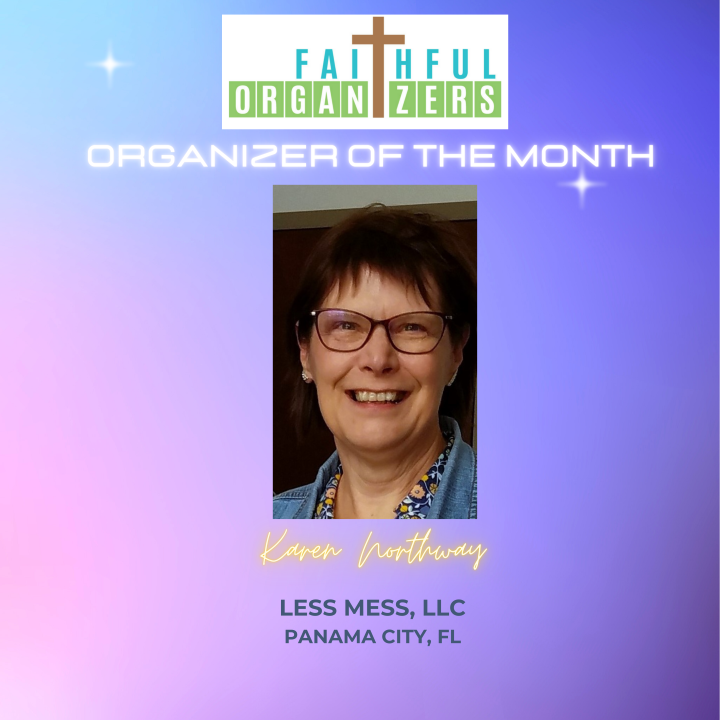
Karen Northway, November 2024 Organizer of The Month
MEET KAREN NORTHWAY!
Karen Northway is a clutter-clearing expert whose mission is to help people live in less clutter so they can live their lives with less distractions. She helps set people up for success so they can achieve their goals for a clutter-free home, because “Less Mess means less stress, better health and a more peaceful heart.”
When she is not organizing she likes to spend time with her husband, two daughters and extended family, as well as volunteering with her church and community. Karen has had her business since 2005 and is a member of Faithful Organizers since 2007.
Contact Information:
Karen Northway
Owner of Less Mess, LLC
Panama City, FL
850-225-1443
FAITHFUL ORGANIZERS’ INTERVIEW WITH KAREN NORTHWAY
Interview hosted by Sangita Evans, Clear and Hear
The Ultimate Guide to Organizing Your Closet by Julie Bertram

Blog post by Julie Bertram, Certified Professional Organizer® owner and CEO of The Organizing Pro, in Charlotte, NC.
A well-organized closet makes every morning routine more efficient. This guide will help you transform your closet into a clutter-free, functional, and stylish space. But first, the most important item for any closet organization is matching hangers :) . I recommend these hangers
1. Assess Your Space
Step 1: Empty Your Closet
Take everything out of your closet. This allows you to see all your items and gives you a blank slate to work with
Step 2: Clean Your Closet
Dust shelves, wipe surfaces, and vacuum the floors. A clean space makes everything better!
2. Sort and Declutter
Step 3: Categorize Items
Sort clothes, shoes, and accessories into categories. For example, separate shirts by tank tops, t-shirts, and long sleeve shirts. Bottoms can be separated by shorts, skirts, jeans, and sweatpants.
Step 4: Declutter
Go through each category and decide which items you want to keep, discard, and donate.
Ask yourself these important questions:
Have I worn this in the past two years?
Does it fit and flatter me?
3. Plan Your Layout
Step 5: Hang Strategically
Group clothing by categories and sort by color (rainbow method, light to dark). Use slim, non-slip hangers to maximize space.
First choice is hang as much as you have space for then fold items that will not wrinkle-like jeans and sweats.
Step 6: Storage Solutions
Consider the types of items you have and the best way to store them.
Hanging organizers for ties and belts
Clear bins for off-season items.
Baskets for shelf storage
It is so important to maintain your closet! Keeping it organized allows for easy seasonal changes and prevents a big mess from building up!
Happy Organizing!
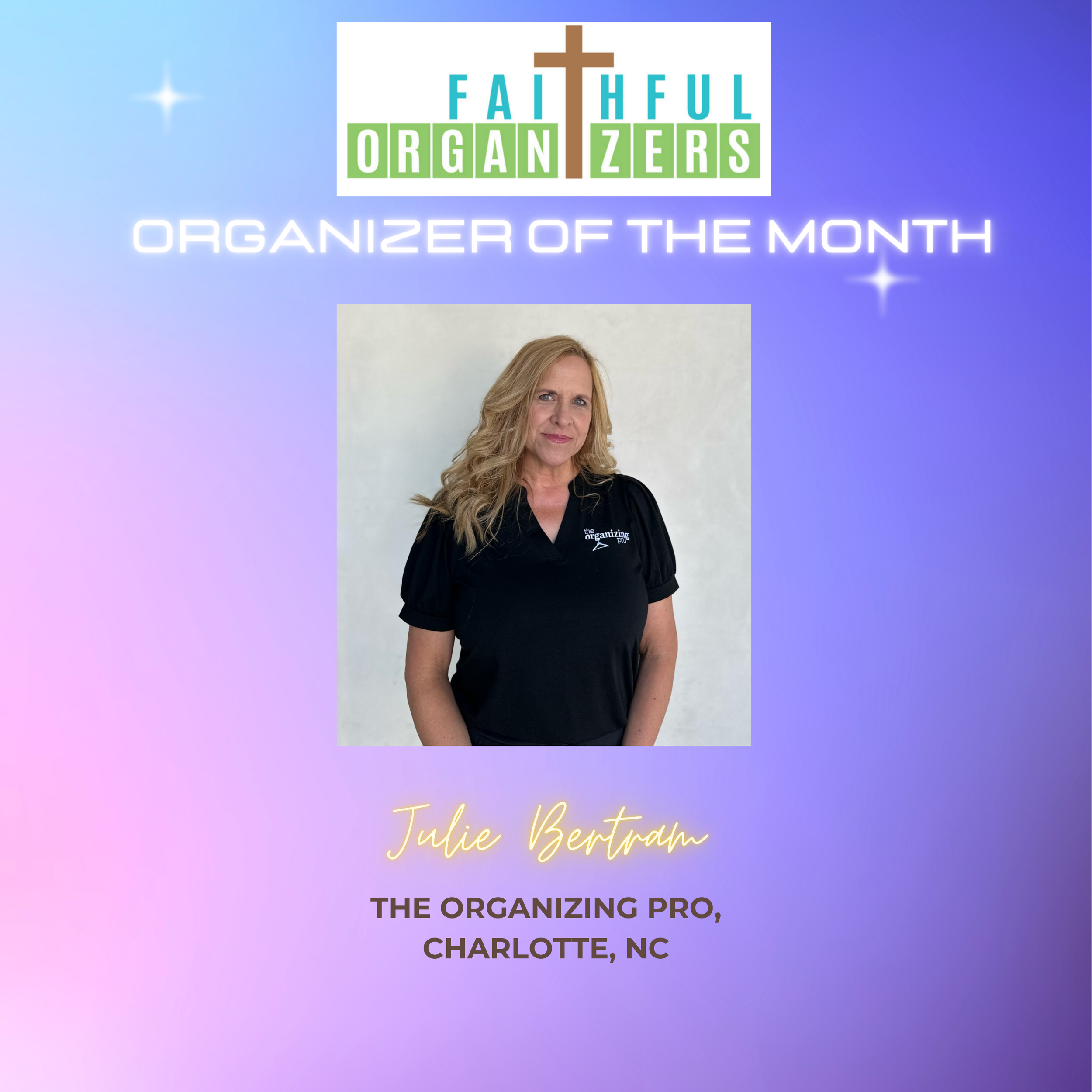
Julie Bertram CPO®, October 2024 Organizer of the Month
MEET JULIE BERTRAM!

Across a 15-year career in real estate, I discovered my passion for problem solving, working with others, and finding the perfect solution for each client. But my favorite part was always preparing their houses for market - reshaping each room into a beautiful new canvas, fresh with possibility.
As a working mom raising three children, creating an efficient flow was always vital to maximizing our time together. Implementing a functional system that our family could follow gave me room to breathe and time back to focus on what mattered the most.
Today, I am the founder of The Organizing Pro and a Certified Professional Organizer®. Since 2001, I have been witness to the profound and lasting impact that organization can create. My clients will often call me after their appointment, marveling in the re-creation of their space. It always makes me smile.
That’s what I strive to do every day - to restore the way you experience your home, one transformation at a time.
Contact Info:
Julie Bertram
julie@theorganizingpro.com
704-517-7350
Her professional info:
Member of NAPO
Multi Person SIG in NAPO
Moving and Relocation SIG in NAPO
Virtual Chapter SIG in NAPO
Certified Professional Organizer
Social Media Handles:
FB: theorganizingpro
IG: theorganizingpro
Linked In: The Organizing Pro
FAITHFUL ORGANIZERS’ INTERVIEW WITH JULIE BERTRAM
Interview hosted by Sangita Evans, Clear and Hear
Elizabeth Tawney Gross CPO®, September 2024 Organizer of the Month

MEET ELIZABETH TAWNEY GROSS!
Elizabeth Tawney Gross has been organizing all her life. She began organizing professionally in 2003 when she launched Organizing For Everyday. An Air Force brat and spouse, she has moved more times than she cares to count. Living in all those different houses is probably what taught her to be organized. She applies that knowledge to helping her residential clients turn their houses into organized homes.
New Mexico’s only dual certified professional organizer
Certified Professional Organizer in Chronic Disorganization®
Certified Professional Organizer®
Member Institute for Challenging Disorganization
Currently serving on the board of directors as Treasurer
Member National Association of Productivity and Organizing Professionals
Founding member Professional Organizers of New Mexico
Member Fellowship of Companies for Christ International
Member of Faithful Organizers
Loves to read “who done it’s.” In series order, of course.
Makes handmade Christmas ornaments for her kids
Quilts when she has the time
Elizabeth is based in Albuquerque, NM and can be reached here;
Email: elizabeth@org4everyday.com
Phone: 505-797-3628
FAITHFUL ORGANIZERS’ INTERVIEW WITH ELIZABETH TAWNEY GROSS
Interview hosted by Sangita Evans, Clear and Hear
Start World Peace – Don’t Organize by Leticia Pfeiffer
Blog post by Leticia Pfeiffer, Certified Professional Organizer® owner and founder of Styled & Organized in Dallas,TX.

Have you ever approached that wasteland you call a pantry, determined to organize those crammed in cans and packages, and ended up eating a whole bag of chips and the cookies you hid from the kids? Organizing areas that have become chaos may be as unnatural for you as speaking a language you have never studied.
A wise person, Kyla Martin of Kyla Martin Coaching & Consulting asked me a year ago to identify my Zone of Genius. Honestly, I didn’t know to what she was referring. I acted in the know, outwardly pondering which of my many Zones of Genius might be my most dominant. Then, I did what any unsure person would do. I asked her what she thought my one Zone of Genius might be. She saved me by answering the question; organizing, styling & making clients feel at ease while tackling both. Ahhhhhhh….that’s a Zone of Genius! Doing what I do best!!
For the past year, that small bit of knowledge has helped me immensely. Every time a decision of To Do or Not To Do comes up, I just ask myself if the task falls into my Zone of Genius.
It’s so freeing!! The guilt of not doing everything is gone. This doesn’t count the daily necessities of making your bed and loading the dishwasher. Why should I take on a task I not only may not like but that falls under one of the following?
It doesn’t come easily
My mind doesn’t think that way
It would take me countless hours to figure out how to get started
I would get stuck while trying to complete the task
I find it an utterly loathsome way to spend my time
I could be doing something fun!
What Kyla was trying to show me is if we all stay in our Zone of Genius – doing what comes naturally to each of us – AND we rely on others for their Zone of Genius, we might just have world peace. Ok, so maybe not that, but we would be less stressed which would make us happier and less likely to lash out at others in the checkout line, therefore, bringing world peace into your little section of the world.
So, the next time you are trying to decide if you should organize your pantry, don’t beat yourself up(and avoid those calories). Instead, call SO to schedule a time for us to organize your pantry. Then, pat yourself on the back and get back to bringing peace into the world with your Genius abilities.
Leticia Pfeiffer, CPO
Website: www.styledandorganized.com
Ph.: 469-360-8696
Email: leticia@styledandorganized.com
Instagram = @styledandorganized
Facebook = StyledAndOrganized
LinkedIn = Leticia Pfeiffer
Leticia Pfeiffer, CPO® August 2024 Organizer of the Month

MEET LETICIA PFEIFFER!
“I love organizing as much as I love helping people find their style. That’s why I became a professional organizer.
I studied Apparel Merchandising at Baylor University, where I quickly discovered my degree combined the creativeness of fashion with the orderliness of organizing — the best of both worlds. My passion to find ways to improve systems and processes became a consistent theme at each job.
In 2009, I launched Styled & Organized, which is my lifestyle service committed to helping clients implement simple organizational solutions to achieve a styled lifestyle that is exceedingly practical. Over the years, my business has evolved to meet the needs of my clients and the growing demands of life.
I enjoy helping clients take back their space while fine-tuning their image — all with stylish solutions, because Life is Better Organized!”
Leticia is based in Dallas, TX and can be reached here;
Website: www.styledandorganized.com
E-mail: leticia@styledandorganized.com
Ph.: 469-360-8696
Instagram = @styledandorganized
Facebook = StyledAndOrganized
LinkedIn = Leticia Pfeiffer
FAITHFUL ORGANIZERS’ INTERVIEW WITH LETICIA PFEIFFER
Interview hosted by Sangita Evans, Clear and Hear
Organizing that Could Save Your Life!
Blog post by Angie Hyche, Certified Professional Organizer® of Shipshape Solutions, Kingsport, TN

It’s a beautiful day, and you’re alone on a walk when you encounter a stranger lying face down beside the trail. The stranger is an unconscious middle-aged woman, and she is lying in a position that makes you think she has fallen. No one else is around, and you’re trying to decide what to do. After attempting unsuccessfully to arouse her, you call 911 to get help.
While waiting for emergency medical services (EMS) to arrive, you search the woman’s bag, hoping to find identification and emergency contact information. You don’t find any identification, but you do find her cell phone. Unfortunately, her screen is locked, and you don’t know the code to unlock it.
A few minutes later, EMS arrives. As they approach the woman, they ask you what you know about her. When you inform them you know nothing, they begin to administer medical care. One of the first responders also searches through the bag. When they see the locked phone screen, they remark, “We’ll just have to do the best we can.”
Now let’s change the scenario slightly. Suppose the woman’s cell phone is set up such that it can be unlocked in an emergency. She has Medical ID set up on her iPhone, so you can access her emergency contacts. While waiting for EMS, you contact a loved one. When first responders arrive, you share her basic health information, which helps them provide the most appropriate care.
Why This Matters for You
We all hope we won’t be caught in a situation like this one, but we still need to be prepared for it! We might be the one to encounter a person in distress, or we might be the one needing help. Having quick access to vital information can make all the difference in an emergency. In fact, it could save your life! The good news is that setting up our cell phone to make this information available is simple.
In this article, I’ll share the basic steps and links for making the information available on your phone in an emergency. Instructions are different for iPhones and Android phones, so you’ll need to use the instructions specific for your phone. Keep in mind that some tools may differ if you’re using an older phone. I am an iPhone user and don’t have experience with Android phones. But I’ll include basic instructions and links for both. Even if you have a hate hate relationship with technology, it’s worth pushing through it to make this information available.
iPhone Instructions
All iPhones come equipped with the Health app. The icon for the app is a simple white square with a pink heart in the upper right hand corner. To add your information, follow these steps:
Open the Health App
Tap on your icon in the upper right corner
Tap on Medical ID
Tap on Edit
Add and edit information
The Health app will pull in some information your iPhone already knows about you. You can add the following information: name, birthday, medical conditions, medical notes (for example, information about recent surgeries or hospitalizations), allergies, current medications, blood type, organ donor status, weight, height, and primary language. You also can add emergency contacts so first responders can notify your loved ones after an accident. These people will automatically be notified if you activate Emergency SOS on your iPhone.
At the bottom of the Medical ID screen, you will see two more options. Show When Locked is important to keep enabled—this is what will allow first responders to see your ID. Share During Emergency Call will automatically share your ID while you’re placing a call to EMS.
You can also view your Medical ID on your Apple Watch:
Press and hold the side button until sliders appear
Slide Medical ID slider to the right
Tap Done
For more help, this article includes a list of instructions. This article, has instructions and screenshots for each step. This YouTube video explains and demonstrates the process step by step.
Android Instructions
Android phones come equipped with the Personal Safety app. Follow these instructions to add information:
Check that you have the latest Android software
On your phone, go to Settings and tap Safety & emergency
Tap Open Personal Safety
Fill in your information
You’ll need to complete one more step to make this information available during an emergency. At the bottom of the Medical Information screen is a box stating, "To help in an emergency, people can view this info without unlocking your device." To turn this option on or off, tap Change Settings and tap the Allow access to emergency info toggle switch.
For more help, this article includes a list of basic instructions. This article has instructions and screenshots for each step. This YouTube video explains and demonstrates the process step by step.
What if I Don’t Have a Smartphone?
Some people wear medical alert bracelets or necklaces. Some of these are also connected to databases with more information. Paper information in a wallet is another option. These are most helpful for medical professionals after you arrive in the emergency room, so it’s good to have your information elsewhere as well.
While doing research for this article, I found a program called Vial of Life that provides people with a form to fill out with medical information. A sticker is then placed on the front door to alert responders.
Who Needs This? Everyone!
I can’t stress strongly enough how important it is for everyone to complete this critical step. Your life could depend on it! It should take only about 5-10 minutes, and the time is well worth it. In fact, I strongly urge you to either stop right now to do it or set some sort of a reminder. We all know how frequently we have the best intentions of completing an important task but then get distracted.
I believe this life-saving information needs to be shared! Please pass this along to anyone you feel could benefit from it. I’m always surprised by how few people have heard about completing this simple and critical task. Complete it yourself, and then share with your loved ones, and either show them how to do it or direct them to helpful resources. Don't underestimate the power you hold.
Contact Information:
Email: angie@shipshape.solutions
Phone: 423-967-2016
Website: Ship Shape Solutions
Social media handles: